Solutions
Platform
Customers
Resources
Solutions
Platform
Resources

Follower count doesn't correlate to the sales a creator generates. We have the data to prove it. What actually drives return is fit, creative, the offer, the audience and where you spend. Here is how to use that.
The creator economy is the most expensive channel still run largely on vanity metrics. For a decade, brands have picked creators, priced them, and judged them on numbers that feel like proof and predict almost nothing: follower count, engagement rate, rate cards, the 6x EMV benchmark everyone quotes and nobody earns. Each one survived because no one had the data to kill it. We do. The Cirqle runs its own MCP over the entire creator-performance dataset, with every sale traced back to the individual creator, which means the myths stop being defensible and just become wrong. Over the next 8 weeks we are releasing eight truths, one a week, each one a chart and a verdict. This is Truth No.1.
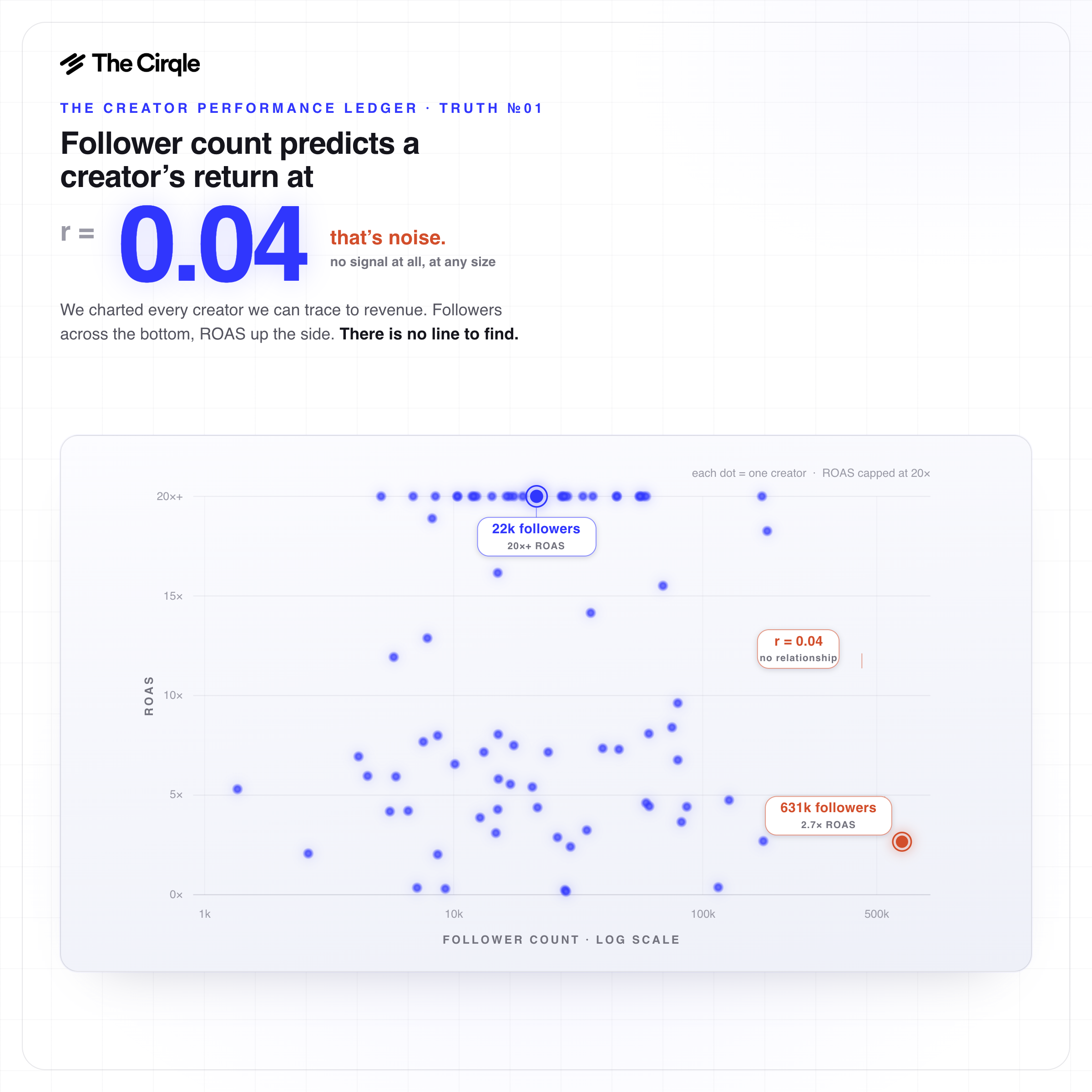
We took every creator we can tie to real sales. We put follower count along the bottom (x-axis) and ROAS up the side (y-axis). Then we checked how closely the two move together and the result is that they barely do. The score came back at 0.04, on a scale where 1 is a perfect match and 0 is no connection at all. So 0.04 is, for all practical purposes, technically a zero correlation.
In plain English: how big a creator is tells you almost nothing about how much money they will make you. You can see it on the chart. One creator with 22,000 followers returned 20x or more. One with 631,000 followers returned 2.7x. The dots are scattered all over the place. There is no line.
Picking creators by follower count is like picking a car by its color and hoping it is fast. The two metrics that the entire industry always looks at are just not related.
Here is the uncomfortable part. Almost every creator program is built on follower count anyway. Brands shortlist by it, rate cards are priced on it, agencies sell tiers named after it: pico, nano, micro, mid, macro, mega. Half the decks in this industry lead with "potential reach," which is just follower count wearing an invisible suit.
Why does this happen if the number does not work? Because follower count is easy to digest and simply sits right there on every profile. You can sort by it in five seconds. Measuring real return is significantly harder and takes real tracking to connect a creator to a sale through deep attribution technologies and layers. Hence, the industry optimizes the number it can see instead of the number that pays the bills. It is the age-old old joke about looking for your keys under the streetlight because that is where the light is, not because that is where you dropped them.
And pricing creators by followers is extremely expensive. When you pay for followers, you overpay for big accounts that convert poorly and you skip small ones that convert beautifully. Worse, because your reporting is also built on (unique) reach, you never really notice discrepancies. The program looks big and busy and loads of creators are onboarded who may produce good looking assets. It just quietly makes less real ROI than it actually should.
The usual next move the industry then follows is to switch to engagement rate. It is better than follower count but still miles off, and not the answer.
Engagement (rate) tells you people enjoy a creator's content, by measuring the likes and comments on a particular post or profile. It does not tell you those people want your product, or that a like turns into a purchase. A creator can be hugely entertaining and still sell nothing, because being fun to watch and being good at selling are two fundamentally different skills. Engagement is a smallclue, not the verdict, definitely not by looking at it in isolation. Useful, but not what you bet real money on.
If follower size is noise and engagement is only a small hint, what should you be looking at? Well, there's three things. We call them the curve, the match, and the four levers.
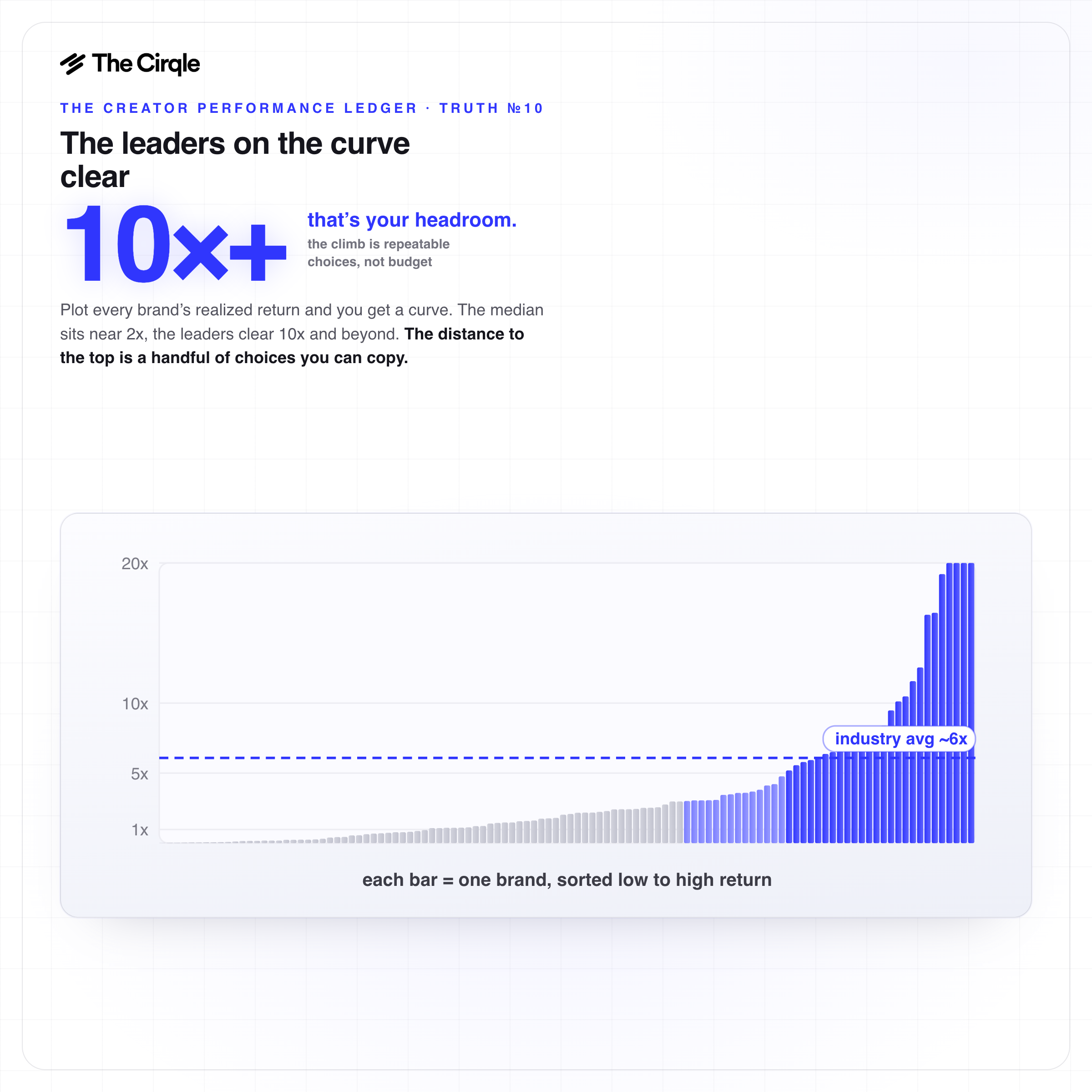
The curve is simply our best estimate of what a specific creator will return for your specific brand, before you spend a cent. It is built from things that actually matter: whether this creator has driven sales before (Historic RoAS score), who their audience really is, whether their content style fits how your product sells, and your own price point. It is not their follower count.
The useful part is what happens over time. Every campaign you run teaches the model something. So the prediction for your fifth campaign is sharper than the one for your first, because it has learned your brand, your buyers, and your products. Your competitor hiring the same creators does not get your learnings. That initial head start is the whole point of being able to outperform the market.
The biggest reason a creator returns 2x or 20x is largely related to fit and two key underlying metrics: "unique reach and engagement rate". Not "do they feel on-brand." Real fit: does their audience actually buy things like yours, and does their content style suit how your product sells. Unique reach speaks about the penetration rate of a creator's ability to reach his/her followers. Engagement rates speaks about how well the audience actually perceives the content.
A skincare creator with 30,000 engaged followers who trust her routine will beat a 500,000-follower generalist on a serum launch every time. Her audience is already shopping for skincare. The trust carries straight into the purchase. Put that same creator on a fintech product and it falls apart, no matter how many followers she has.
The lesson: fit is about the pair (of metrics), not the person. A great creator for one brand is a poor one for another. You have to judge the match, not the name, and look at the underlying metrics that power your choice.
Once you have picked for fit, four things drive the result. These are the dials you turn, campaign after campaign.
Notice what is missing from that list. Follower count. It is a byproduct, not a dial you turn and as the graph above illustrates is not correlated to actual return (sales).
Practically, the new playbook is simple:
None of those steps care how many followers anyone has.
Follower count predicts return at 0.04. Once that sinks in, every dollar you spend based on reach is a dollar spent on a number that does not work. The creators who carry your program are not the biggest names. They are the best fits, found by the curve and scaled with the four levers.
We are publishing the Creator Performance Ledger because this category has been priced on the wrong number for a decade. The brands that switch to the right one first will pull ahead before the rest even notice. This was Truth Nº01, and we have 7 more truths coming.
The data behind this research lives in The Creator Performance Ledger, our full research report on what actually drives real return in creator marketing. Truth No.1 is one research piece out of dozens. The full report breaks down selection, creative, cost, and measurement across hundreds of brands where we can trace every sale to a specific creator, and it is the foundation for everything in this series. We are releasing it to a small group ahead of the public drop. If you want early access before the next seven truths land, grab it below by leaving your details.
Give your team the power and speed they need to find the right partners and grow your brand.
%201.avif)